
The Hidden TrackMan Number That Explains Your Shot Shape

Most golfers walk into a TrackMan golf lesson and look straight at the obvious numbers.
Carry distance.
Ball speed.
Club speed.
Spin rate.
They are all useful. But if you want to understand why your ball curves, there is one TrackMan tile that deserves far more attention.
Face to Path.
This is one of the most important numbers for golfers who slice, hook, fade, draw, push or pull the ball. It explains the relationship between where the clubface is pointing and the direction the club is travelling through impact.
In simple terms, Face to Path helps explain your shot shape.
What Does Face to Path Mean?

Face to Path is the difference between your Face Angle and your Club Path.
Club Path tells us the direction the club head is moving through impact.
Face Angle tells us where the clubface is pointing at impact.
Face to Path tells us the relationship between the two.
That relationship is what creates curve.
For a right handed golfer, if the face is open to the path, the ball will tend to curve to the right.
If the face is closed to the path, the ball will tend to curve to the left.
If the face and path are closely matched, the ball will usually curve less, assuming strike is fairly centred.
This is why Face to Path is such a powerful TrackMan number. It does not just tell you what happened. It helps explain why it happened.
Why This Matters For A Slice
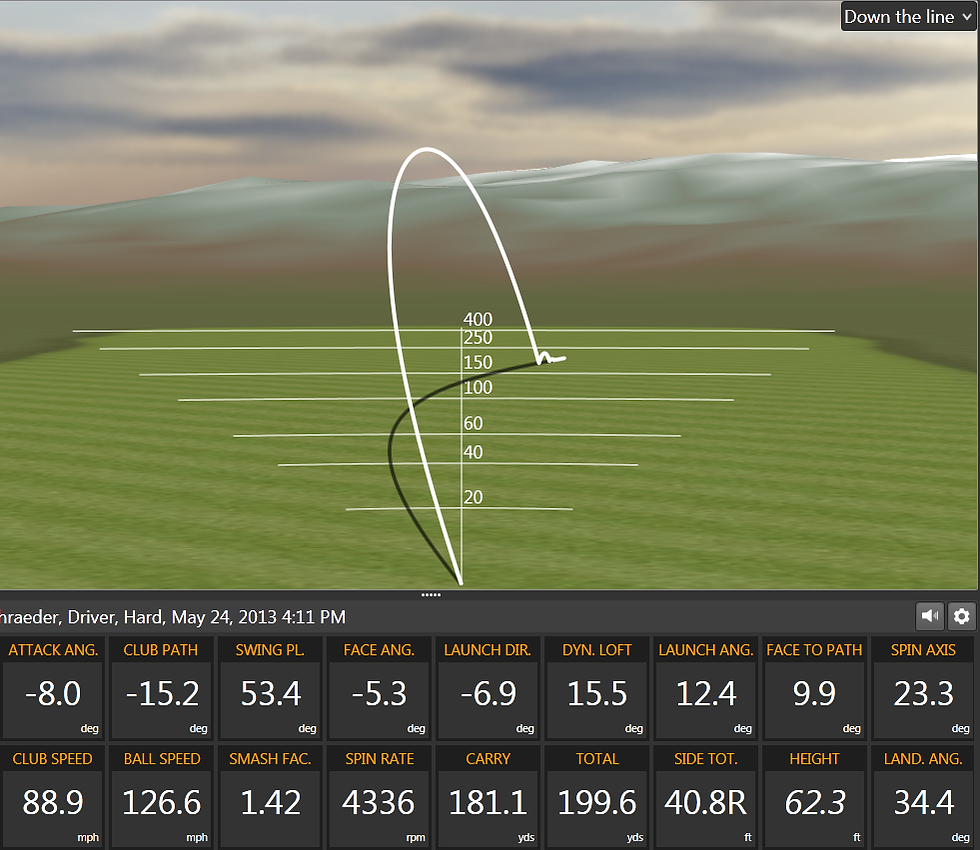
A lot of golfers try to fix a slice by aiming further left.
The problem is, that often makes the slice worse.
For example, if your club path is moving left and your clubface is still open to that path, the ball is going to curve right. You may be aiming further left, but the relationship between face and path has not improved.
That is why a slice is rarely just an aiming issue.
It is usually a face and path issue.
Once you understand this, the fix becomes clearer. You are no longer guessing. You are trying to improve the relationship between the clubface and the direction the club is travelling.
Why This Tile Is A Hidden Gem
Face to Path is a hidden gem because it connects so many common golf problems.
It helps explain why you slice your driver.
It helps explain why your draw turns into a hook.
It helps explain why a ball can start on line and still curve away from the target.
It helps explain why one swing produces a fade and the next one produces a big miss.
Many golfers look at Club Path on its own. Others look at Face Angle on its own.
But the real gold is in the relationship between the two.
That is why I like Face to Path so much in a lesson. It gives the golfer a simple picture of what is happening at impact.
How I Use Face to Path In A TrackMan Lesson
At Five Iron Golf Mentone, I use TrackMan to help golfers stop guessing.
If a player is slicing the ball, I do not just say “swing more from the inside” or “close the face.”
First, I want to know what the numbers are showing.
Is the club path too far left?
Is the face too open?
Is the strike making the curve worse?
Is the golfer aiming in a way that makes the pattern harder to manage?
Face to Path helps us answer those questions quickly.
From there, we can build a better plan. Sometimes the golfer needs a grip adjustment. Sometimes they need a different backswing feel. Sometimes they need to change how the clubface is delivered earlier in the downswing. Sometimes they simply need to understand their start line and curve better.
The number gives us clarity.
A Simple Way To Practise It
Next time you are practising on TrackMan, do not only look at distance.
Look at Face to Path.
Hit five normal shots and check the pattern.
If the number is consistently too open to the path, the ball will usually curve one way.
If the number is consistently too closed to the path, the ball will usually curve the other way.
Your goal is not always to make the number zero. Your goal is to make it match the shot shape you actually want to play.
That is the key.
Good golf is not about hitting perfectly straight shots every time. It is about building a predictable ball flight you can trust.
Want To Understand Your Own Swing?

For a limited time, I’m offering online swing lessons for $29.
Upload your swing and I’ll send back a personalised video analysis explaining what is happening in your motion, why the ball is flying the way it is, and what you should work on next.
If you are slicing, hooking, pushing, pulling, or just unsure what your natural shot shape should be, this is a simple way to get clear coaching feedback without needing to come in for a full lesson.
Stop guessing. Send your swing and I’ll show you what to fix.
Get your $29 online lesson now!


Comments